Forget the delicate braises of your grandmother's Sunday dinner; we are entering the realm of structural engineering. When you commit to a Lamb Shank Slow Cook, you are not merely making dinner. You are managing a multi-hour architectural collapse of collagen into gelatinous glory. The lamb shank is a masterpiece of connective tissue, a hardworking muscle wrapped in a stubborn sheath of silver skin that mocks the impatient chef. To master this cut, you must embrace the paradox of heat: too much, and the proteins contract into a dry, fibrous husk; too little, and you are left chewing on a rubberized gasket. We are looking for the precise moment where the triple-helix structure of collagen denatures, flooding the sauce with a viscous, lip-smacking richness that coats the palate. This is high-stakes chemistry disguised as comfort food. We will use thermal energy to dismantle the animal's structural integrity, transforming a tough limb into a succulent, fork-tender relic that slides off the bone with the slightest provocation. Prepare your workstation. We are about to turn physics into flavor.
THE DATA MATRIX
| Metric | Specification |
|---|---|
| Prep Time | 45 Minutes |
| Execution Time | 4 to 6 Hours |
| Yield | 4 Servings |
| Complexity (1-10) | 6 |
| Estimated Cost per Serving | $12.00 – $15.00 |
THE GATHERS
Ingredient Protocol:
- 4 Large Lamb Shanks (approx. 1.6kg / 3.5 lbs total)
- 60ml / 4 tbsp High-smoke point oil (Grapeseed or Avocado)
- 250g / 2 Large Yellow Onions, finely diced
- 200g / 3 Large Carrots, cut into 1cm rounds
- 150g / 3 Ribs Celery, sliced
- 45g / 3 tbsp Tomato Paste
- 750ml / 3 cups Full-bodied Red Wine (Cabernet or Syrah)
- 500ml / 2 cups Fortified Beef or Lamb Bone Broth
- 5g / 4 Sprigs Fresh Rosemary
- 3g / 6 Sprigs Fresh Thyme
- 4 Large Garlic Cloves, smashed
- 15g / 1 tbsp Kosher Salt (plus more for seasoning)
- 5g / 1 tsp Freshly Cracked Black Pepper
Section A: Ingredient Quality Audit:
If your lamb shanks arrive with an excessive, waxy fat cap, do not leave it entirely intact. While fat is flavor, an overabundance will lead to a greasy, broken emulsion in your final sauce. Use a sharp boning knife to trim the exterior to a uniform 3mm thickness. If your red wine is "corked" or overly acidic, it will ruin the piquant balance of the braise. Never cook with a wine you would not drink; the reduction process only concentrates flaws. If your bone broth lacks body (it should be jelly-like when cold), supplement it with 5g of unflavored gelatin bloomed in cold water. This ensures the final sauce has the necessary viscosity to cling to the meat.
THE MASTERCLASS
1. The Maillard Initiation
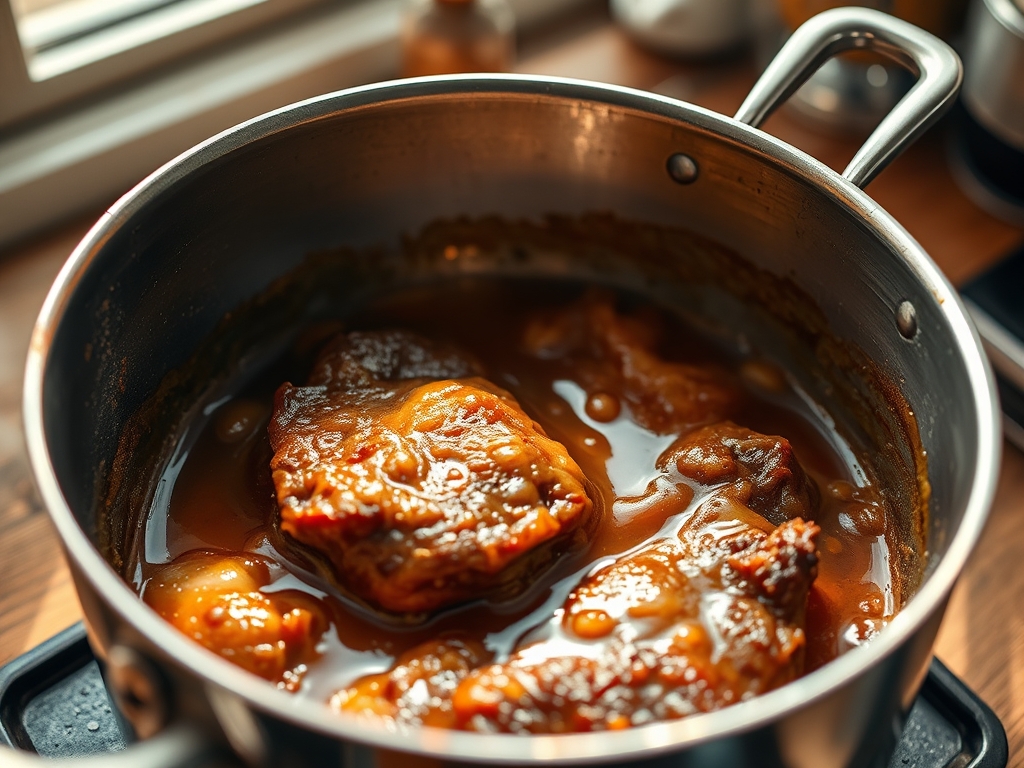
Pat the shanks bone-dry with paper towels. Use a digital scale to measure your salt, then season the meat aggressively on all sides. Heat your heavy-bottomed Dutch oven or a copper-core saucier over medium-high heat. Add the oil and sear the shanks until a deep, mahogany crust forms. Do not crowd the pan; work in batches if necessary to maintain surface temperature.
Pro Tip: Moisture is the enemy of the Maillard reaction. By drying the surface, you ensure that thermal energy goes toward browning rather than evaporating surface water. A heavy-duty saucier provides the even heat distribution required to prevent hot spots during this critical phase.
2. Aromatics and Fond Management
Remove the meat and set it aside on a stainless steel prep tray. Reduce the heat to medium and add the onions, carrots, and celery. Use a wooden spoon or a silicone spatula to scrape the "fond" (the caramelized protein bits) from the bottom of the pot. Sauté until the vegetables are translucent and beginning to caramelize at the edges.
Pro Tip: The fond contains concentrated umami compounds. Adding a splash of water or a bit of the vegetable moisture helps release these molecules, integrating them into the base of your stew. A bench scraper is excellent for cleaning your cutting board of all vegetable trimmings to ensure zero waste.
3. The Tomato Paste Catalyst
Clear a small space in the center of the vegetables and add the tomato paste. Cook the paste for 2 to 3 minutes until it turns from bright red to a rusty brick color. This "pincé" technique removes the raw metallic taste of the paste and deepens the flavor profile.
Pro Tip: Cooking the tomato paste in direct contact with the pan bottom caramelizes its natural sugars. This adds a layer of complexity that balances the gaminess of the lamb. Use a digital thermometer to ensure your pan surface stays around 150C (300F) to avoid burning the sugars.
4. Deglazing and Fluid Integration
Pour in the red wine, using the liquid to further deglaze the pan. Increase the heat and let the wine reduce by half. This evaporates the harsh ethanol and concentrates the fruit esters. Add the bone broth, garlic, and herbs. Return the shanks to the pot, ensuring they are submerged at least halfway in the liquid.
Pro Tip: Reducing the wine is non-negotiable. If you skip this, the final sauce will have a sharp, boozy bite that masks the subtle notes of the lamb. A digital scale ensures your liquid ratios are precise, which is vital for the eventual reduction of the sauce.
5. The Low-Slow Hydrolysis
Cover the pot with a tight-fitting lid or a layer of parchment paper followed by foil (a cartouche). Place in a preheated oven at 150C (300F). Allow the Lamb Shank Slow Cook to proceed for 3 to 4 hours. Every hour, use tongs to rotate the shanks, ensuring even exposure to the braising liquid.
Pro Tip: The low temperature prevents the muscle fibers from tightening too quickly. A "cartouche" creates a pressurized environment that keeps the top of the meat moist, preventing it from drying out before the interior collagen has fully converted to gelatin.
6. The Final Emulsion and Glaze
Once the meat is tender, remove the shanks carefully. Strain the braising liquid through a fine-mesh chinois into a clean saucepan. Simmer the liquid until it reduces to a coating consistency. Whisk in a knob of cold butter if desired to aerate and emulsify the sauce for a glossy finish. Pour the glaze over the shanks before serving.
Pro Tip: Straining the liquid through a chinois removes the spent vegetable fibers, resulting in a professional, silky texture. This is where the dish transitions from a rustic stew to a refined culinary masterpiece.
Section B: Prep & Timing Fault-Lines:
The most common failure in a Lamb Shank Slow Cook is rushing the clock. If the meat is "bouncy" or resists the fork, the collagen has not yet melted; give it another 45 minutes. Conversely, if the meat is disintegrating into the liquid like wet paper, you have overshot the mark and the proteins have completely denatured. Check the internal temperature with a digital probe; you are looking for an internal "sweet spot" of 90C to 95C (195F to 205F). If your oven runs hot, reduce the temperature to 135C (275F) to extend the window of perfection.
THE VISUAL SPECTRUM
Section C: Thermal & Visual Troubleshooting:
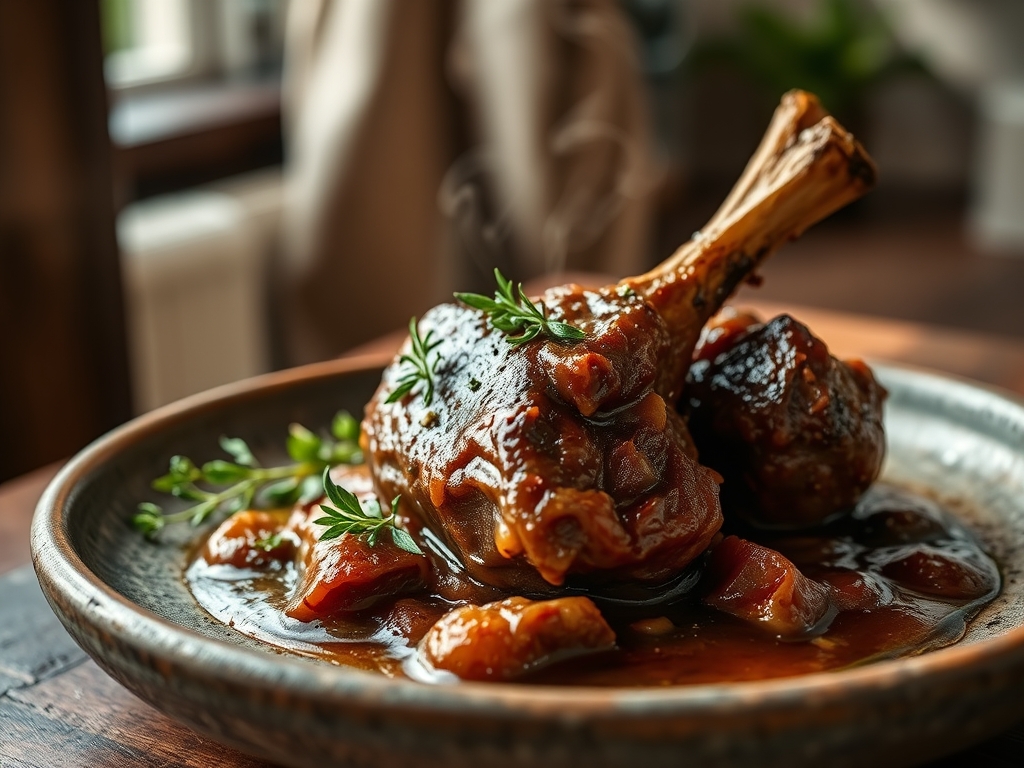
Referencing the Masterclass photo, your shanks should exhibit a deep, uniform dark-brown glaze, not a pale grey or charred black. If the meat looks dull, your sauce reduction was insufficient; it needs more time on the stovetop to concentrate the sugars and fats. If you see "oil slicks" on the surface, the sauce has broken. Fix this by whisking in a tablespoon of warm water or using an immersion blender to re-emulsify the fats. The vegetables should be soft but still hold their shape; if they have vanished into a mush, they were cut too small for the long cook time.
THE DEEP DIVE
Macro Nutrition Profile:
A single lamb shank provides approximately 45g of protein and 30g of fat. It is exceptionally high in Vitamin B12, Zinc, and Selenium. The high gelatin content from the connective tissue supports gut health and joint integrity.
Dietary Swaps:
- Vegan: Replace lamb with large "steaks" of Lion's Mane mushroom or celery root; use vegetable demi-glace and red wine.
- Keto: Ensure the red wine is dry (low residual sugar) and omit the carrots; replace with daikon radish.
- GF: This recipe is naturally gluten-free; just ensure your bone broth has no hidden grain-based thickeners.
Meal Prep & Reheating Science:
Lamb shanks actually improve after 24 hours in the refrigerator. As they cool, the gelatin sets into a semi-solid matrix that traps the flavor molecules. To reheat, do so gently in a covered pot with a splash of water or broth. Avoid the microwave, as it vibrates water molecules too violently, which can cause the delicate fat-protein emulsion in the sauce to break.
THE KITCHEN TABLE
How do I know when the shanks are truly done?
The meat should pull away from the bone with minimal resistance from a fork. The "bone pull" is the ultimate indicator; if the meat has retracted up the bone by at least an inch, the connective tissue has successfully hydrolyzed.
Can I do this in a slow cooker instead?
Yes, but you must sear the meat and sauté the aromatics in a separate pan first. Set the slow cooker to "Low" for 8 hours. Note that the sauce will not reduce, so you must thicken it manually afterward.
Why is my sauce so thin after four hours?
The lid on your pot may be too tight, preventing evaporation, or the lamb released more moisture than expected. Remove the meat and boil the liquid vigorously in an open pan to reduce and concentrate the flavors and gelatin.
What is the best wine for this braise?
Choose a wine with high tannins and moderate acidity, such as a Malbec or a Cabernet Sauvignon. The tannins bind with the proteins in the lamb, softening the meat while providing a robust structural backbone to the sauce.